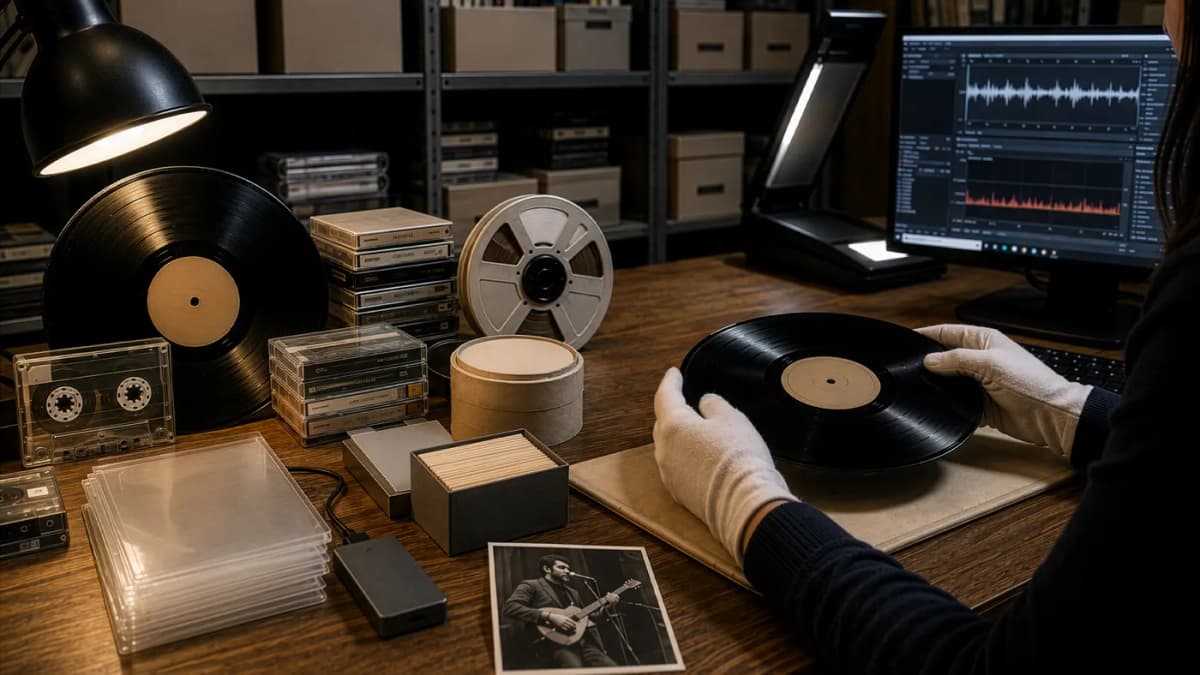
Music recordings are not viewed solely as audio files or physical media created for listening. They also form part of cultural memory as documents that reflect the production methods, performance approaches, recording technologies, and musical preferences of a particular era. For this reason, preserving different formats—from vinyl records and cassettes to reel-to-reel tapes and digital recordings—helps ensure that music produced in the past remains accessible in the future.
One of the main challenges in preserving audio recordings is that physical formats can deteriorate over time. Vinyl records may wear down or become deformed, magnetic tapes can degrade, and older media such as cylinders can be particularly fragile and vulnerable to breakage. In addition, the equipment required to play these recordings may become obsolete, which can also affect the accessibility of archives. For this reason, proper storage conditions and appropriate digital transfer methods are among the essential practices for preserving audio heritage.
Digitization is one of the ways to make the content of physical recordings accessible through current technologies. However, the archiving process is not complete simply by converting a recording into a digital file. The format in which the file is stored, how it is backed up, how information about the recording is documented, and how it will be transferred to new systems in the future are all part of long-term preservation. Technical guidelines for audio archiving often address metadata, persistent identifiers, digital storage, data management, and access together, reflecting the multi-layered nature of the process.
Preserving only the audio content of a recording may also be insufficient. Information such as the title of the work, the artist, recording date, physical carrier, recording conditions, and other source-related details is important for ensuring that a work can be accurately identified in the future. Cataloguing standards developed for audio and audiovisual archives likewise focus on describing recordings and enabling the exchange of information within a shared system.
The cultural value of music archiving becomes especially visible through access. When preserved recordings can be revisited by researchers, students, musicians, and listeners, past productions can not only be stored but also rediscovered. Keeping audio recordings accessible for educational and research purposes is considered one of the key objectives of archival work.
From this perspective, music archiving can be understood as more than the storage of recordings from the past; it is a way of carrying musical memory into the future in a sustainable manner. When the preservation of physical media, the creation of digital copies, the organization of recording information, and continued access are considered together, the archive becomes one of the living resources of music history.