

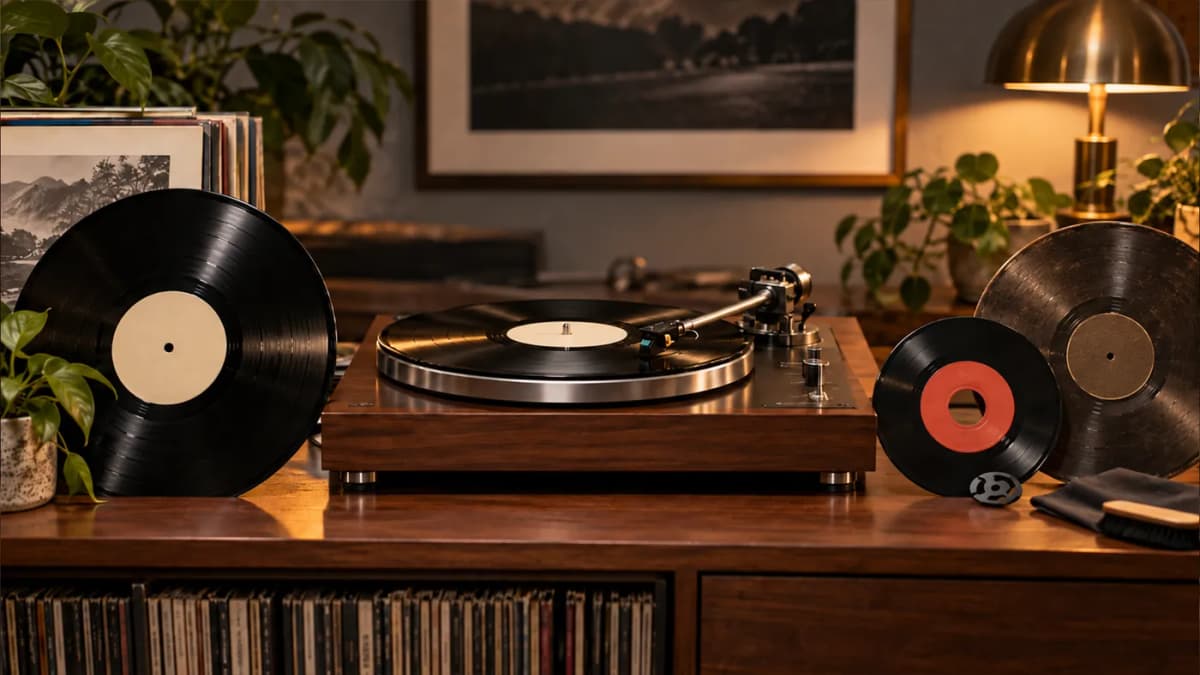
The terms 33, 45, and 78 RPM indicate how many revolutions per minute a record should make on a turntable. Choosing the correct speed is important for hearing the recording at its intended tempo and tonal character. The size of a record may provide a clue, but the most reliable information is the speed printed on the center label or sleeve.
The speed commonly referred to as “33 RPM” is technically 33⅓ revolutions per minute. This speed is especially common for long-playing records. Because a 33⅓ RPM record can hold multiple tracks on each side, it is well suited to listening to an album from beginning to end in a defined sequence.
It is not always possible to determine a record’s speed based solely on its size. Although many large records play at 33⅓ RPM, pressings also exist at other speeds. For this reason, checking the label before placing a new record on the turntable is the safest way to ensure the correct listening experience.
45 RPM records play at 45 revolutions per minute and are often associated with single releases. Smaller 45 RPM records are very common, although larger 45 RPM pressings also exist. Record diameter and playback speed should therefore be treated as separate characteristics.
Some 45 RPM records have a larger center hole than standard records. An appropriate adapter can be used to position these records correctly on the turntable spindle. The playback speed itself is selected through the turntable’s speed control.
78 RPM records are most commonly associated with older recordings. Many examples known in Türkiye as “taş plak” were produced from shellac-based materials. Their structure can differ significantly from the vinyl records widely used today. Listening to a 78 RPM recording may therefore require not only a turntable capable of supporting the correct speed but also an appropriate stylus and cartridge.
Particular care should be taken with records found in family archives or older collections. Identifying the material from which a record was made and the speed at which it should be played helps protect it. It is also important to check whether the turntable and stylus being used are suitable for that type of record.
Selecting the wrong speed directly changes the way the music sounds. If a record is played faster than intended, the tempo increases and the sound becomes higher in pitch. If it is played at a lower speed, the music slows down and the sound becomes deeper. For example, playing a record designed for 33⅓ RPM at 45 RPM will noticeably alter both the tempo and the character of the vocals.
Before listening, a few simple checks are usually enough. First, read the speed information on the center label. Then make sure your turntable supports that speed and that the stylus you are using is appropriate for the record type. If the record has a large center hole, insert the correct adapter.
Information on a label may become faded or unreadable over time. In such cases, you can research the pressing using the artist name, song or album title, and catalog number. With second-hand records, checking the record’s own label is also useful for confirming that the sleeve and the record belong to the same pressing.
As a collection grows, recording basic information about each record can make it easier to manage. You can create a simple list containing the artist, album title, pressing year, condition, and playback speed. This allows you to keep track of your collection without having to search for speed information each time you listen.
Understanding the differences between 33, 45, and 78 RPM is one of the fundamentals of vinyl listening. Selecting the correct speed allows recordings to be heard at their intended tempo and closer to their intended sonic character. Recognizing different record formats also helps you build a collection more consciously and care for older recordings more carefully.